
Challenges in Hospital Management & How to Fix Them
Indian hospitals and clinics lose time, revenue, and patient trust when operations rely on paper records, manual billing, and disconnected systems. A hospital management system (HMS) addresses each of these pressure points — from OPD queues to pharmacy stockouts — in a structured, auditable way. This post walks through the eight most common problems and what addressing them actually looks like in practice.
Last updated: June 2026
Running a hospital or clinic in India has never been straightforward. Between managing patient flow, staff schedules, regulatory requirements, and billing cycles, administrators are constantly pulled in too many directions. When any one of these systems breaks down — paper records get misplaced, a duty roster has a gap, a billing code is wrong — the ripple effects reach patients, staff, and the balance sheet simultaneously.
This post is not about technology for its own sake. It is about the specific operational problems that hospital administrators, clinic owners, and doctors report most consistently — and the practical mechanisms by which digital systems address them. If you are evaluating whether to upgrade your current processes, understanding the actual problem list is the right place to start.
For a view of what hospitals gain after addressing these challenges, see our companion post: Advantages of a Hospital Management System.
The Core Challenges in Hospital Management
1. Paper-Based and Manual Record-Keeping
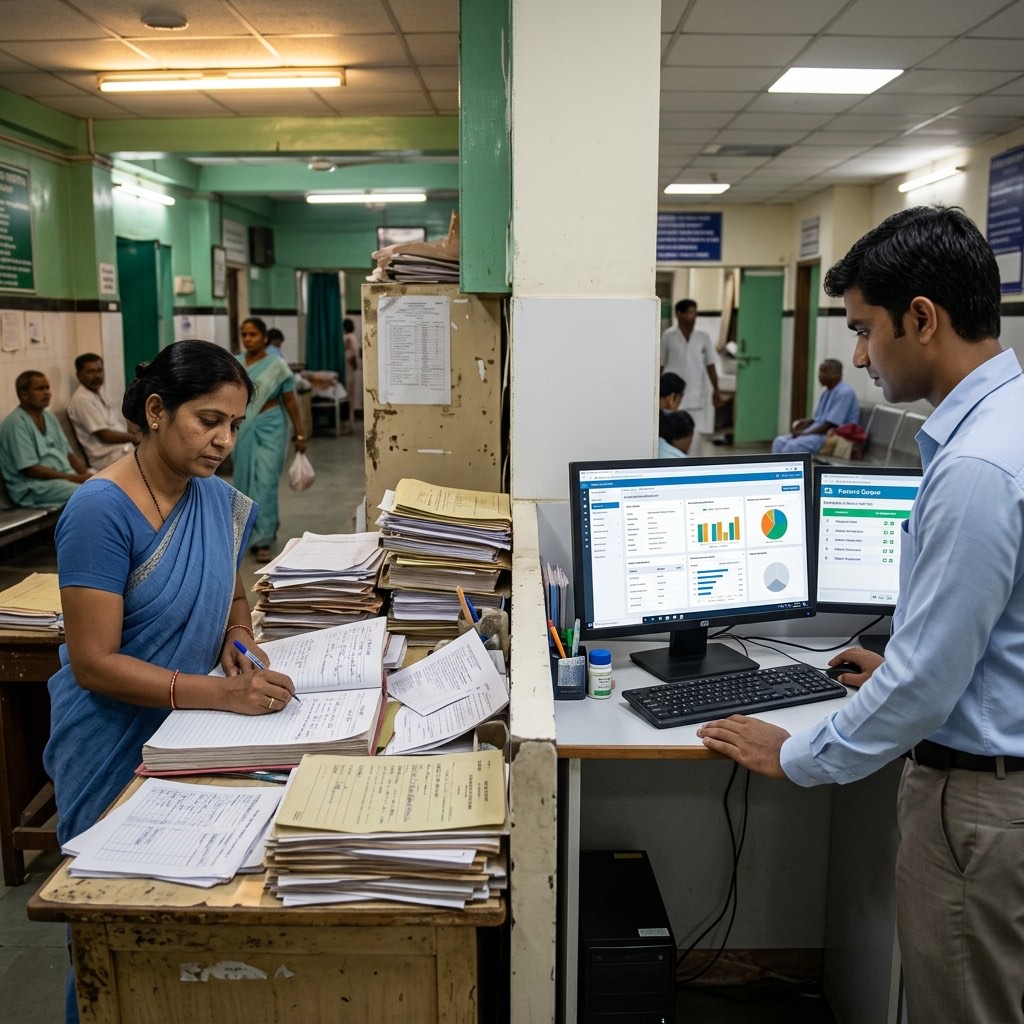
Paper records are the single most common source of operational friction in Indian hospitals. Case files get misplaced between OPD and IPD. Handwriting is misread. Test reports are filed separately from prescriptions. When a patient arrives at the pharmacy counter or the billing desk, the record-room staff has to physically retrieve a file that may or may not be in the right location.
The downstream effects include duplicate investigations, prescription errors, delayed discharges, and patients who simply give up and leave. In multi-department hospitals, the problem compounds because no single person has a complete view of the patient's current status.
An electronic medical record (EMR) system creates a single, accessible patient file. Every department — OPD, IPD, pharmacy, billing, diagnostics — works from the same record. Changes are logged, access is auditable, and nothing depends on a physical file being in the right drawer.
For more on how this is structured in practice, see What Is a Hospital Management System?
2. Revenue and Billing Leakage
Billing errors in hospitals rarely involve fraud. They involve missed charges. A ward procedure gets done but the charge slip is not filled. A consumable is used but not recorded. A doctor visit happens but is not billed because the patient was transferred mid-shift.
Manual billing processes make it easy for charges to slip through, and the cumulative effect on monthly revenue is substantial. GST compliance adds another layer of complexity — incorrect tax categorization creates reconciliation problems and potential audit exposure.
An integrated billing module captures charges at the point of care, ties them to the treating doctor and the department, and applies the correct GST codes automatically. The billing desk sees a complete ledger before generating the final bill, rather than reconstructing it from memory or physical slips.
3. Long OPD Queues and Patient Wait Times
Patient wait times are both an operational problem and a reputation problem. In busy OPDs, patients may wait two or three hours to see a doctor for a ten-minute consultation. The bottleneck is usually not the doctor — it is the registration process, the record retrieval, and the queue management system (or lack of one).
Without appointment scheduling, patients arrive in unpredictable clusters. Without a queue display system, patients have no visibility into wait time and frequently ask staff for updates — which itself consumes staff time.
Appointment scheduling and OPD queue management tools allow patients to book specific time slots, notify them when their turn is approaching, and give front-desk staff a live view of the day's flow. Registration becomes faster when patient records are already in the system from a previous visit.
More on OPD-specific tools: OPD Management Software
4. Staff Coordination and Duty Roster Management
In a hospital that operates 24 hours, staff scheduling is genuinely complex. Nurses, ward staff, housekeeping, and junior doctors rotate across shifts. Errors in the roster — a gap in the night shift, a doctor marked present who is actually on leave — create immediate patient safety risks and administrative chaos.
When rosters are managed on spreadsheets or paper, the person managing them spends significant time each week maintaining and distributing them. When a staff member calls in sick, there is no fast way to identify who is available to cover.
A hospital ERP with staff scheduling functionality maintains the roster digitally, tracks attendance, and flags coverage gaps before they become emergencies. Leave management and payroll data connect to the same system, reducing the administrative burden on HR and accounts.
5. Pharmacy and Inventory Stockouts
Pharmacy and inventory management is where many hospitals absorb silent losses. Medicines expire on the shelf when over-ordered. Critical drugs run out when consumption spikes. Surgical supplies disappear without a corresponding billing record.
Manual stock-taking is periodic, which means problems are discovered after the fact. When a patient at the pharmacy counter is told a prescribed medicine is out of stock, they lose confidence in the facility — and the encounter ends on a negative note regardless of the quality of care provided.
A pharmacy management module tracks inventory in real time. Reorder alerts trigger before a stockout, not after. Dispensing records tie back to prescriptions, which makes it possible to identify discrepancies between what was prescribed, what was dispensed, and what was billed.
6. Regulatory, NABH, and ABDM Compliance
Indian healthcare facilities face an expanding compliance surface. NABH accreditation requires documented processes, audit trails, and staff training records. ABDM (Ayushman Bharat Digital Mission) mandates a specific Health ID infrastructure for facilities that want to participate in government schemes or issue linked health records.
Managing compliance manually — tracking which documents have been renewed, which staff certifications are current, which patient records qualify for ABDM linking — is a significant administrative burden. When an inspection happens, the scramble to assemble documentation is stressful and error-prone.
Digital systems create compliance records as a byproduct of normal operations. An ABDM compliant HMS creates and links Health IDs at registration, generates the audit trails that NABH requires, and maintains the documentation in a retrievable format. Learn more about what ABDM means for your facility: What Is ABDM?
7. Data Security and Patient Confidentiality
Patient data is sensitive in ways that most other business data is not. A billing spreadsheet left open on a shared computer, a physical prescription pad left in a common area, a WhatsApp group used to share test reports — these are common in Indian healthcare facilities and represent real confidentiality risks.
Beyond the ethical dimension, there are regulatory requirements under India's data protection framework for how patient information must be stored and accessed. Facilities that rely on informal channels have no audit trail and no way to demonstrate compliance if challenged.
An HMS with role-based access ensures that a billing clerk cannot view clinical notes, that a nurse can access the medication schedule but not financial records, and that every access event is logged. Data is stored in a defined location rather than scattered across personal devices and shared drives.
8. Fragmented Systems That Do Not Talk to Each Other
Perhaps the most pervasive challenge in hospital management is the patchwork problem. A facility may have a billing software, a separate pharmacy system, a lab module from a third vendor, and patient records maintained in a spreadsheet. Each system works within its own boundary. Staff spend time re-entering data from one system into another — which introduces errors and delays.
When a department head needs to review the month's performance, the data is in three different places and requires manual assembly. When a patient moves from OPD to IPD, their record does not automatically follow them.
An integrated HMS consolidates these functions into a single platform. Hospital management system modules — OPD, IPD, pharmacy, billing, lab, reports — share a common patient record. Information entered at one step is available at the next without manual transfer.
Hospital Management Challenges at a Glance
| Challenge | Impact on the Hospital | How an HMS Addresses It |
|---|---|---|
| Paper-based records | Misfiled files, prescription errors, delayed discharge | EMR with multi-department access; full patient history in one place |
| Billing and revenue leakage | Missed charges, GST errors, reconciliation gaps | Integrated billing tied to care events; automated GST categorization |
| OPD queues and wait times | Patient dissatisfaction, staff overload at front desk | Appointment scheduling, live queue management, pre-registered patients |
| Staff scheduling gaps | Coverage gaps, patient safety risks, payroll errors | Digital duty roster with leave management and attendance integration |
| Pharmacy stockouts | Dispensing failures, patient trust issues, stock losses | Real-time inventory tracking with automated reorder alerts |
| Regulatory compliance burden | Audit risk, NABH documentation scrambles, ABDM gaps | Compliance records generated automatically; ABDM compliant patient linking |
| Data security | Confidentiality breaches, no audit trail | Role-based access control; centralized, logged data storage |
| Fragmented systems | Duplicate data entry, no unified view | Single integrated platform covering all departments |
Where to Start
If your facility is dealing with two or three of the challenges above, you are not facing an unusual situation — you are dealing with what most Indian hospitals and clinics face at some point in their growth.
The practical starting point is not to try to solve every problem at once. It is to identify which problems are causing the most visible harm right now — whether that is billing leakage, patient wait times, or compliance documentation — and address those first.
A hospital management system that covers your core departments and grows with you is more useful than one with exhaustive features that overwhelms your team. Before committing to any software, it is worth understanding how to choose hospital management software and evaluating options against your specific operational needs.
Lifemaan is a hospital and clinic management platform used by 576+ facilities across India. It covers OPD, IPD, ICU, billing, pharmacy, EMR, appointment management, and more. It is ABDM compliant and includes tools such as AI-assisted handwriting digitization and Speech-to-Rx in 22 major Indian languages plus English and Hinglish — designed for the clinical realities of Indian practice. The Heroes of Lifemaan doctor app is available on Android and iOS.
If you want to see how Lifemaan addresses your specific challenges, book a free demo.
Frequently Asked Questions
Want to see Lifemaan in action?
Schedule a free demo for your hospital or clinic. See how easy the switch to digital can be.
Book Free Demo