
Pediatric Practice Software
Growth Charts, Vaccination, Quick OPD
40 kids before lunch. Write the prescription in 10 seconds. Send it on WhatsApp.
Why Paediatricians Choose Lifemaan
Don't Change Your Habit
Write on tablet like paper. Same handwriting, same speed — your prescriptions are digitized instantly. No typing, no templates.
Patient Forgets File? No Worries
Digital records always accessible. Pull up any child's complete history — vaccinations, growth data, past prescriptions — in one tap.
Educate Patients at No Extra Cost
Show anatomy images on tablet during consultations. Help parents understand their child's condition, nutrition needs, and developmental milestones visually.
Digital Vaccination Chart with Auto-Reminders
Complete vaccination schedule per child. Auto WhatsApp reminders to parents when next dose is due. No follow-up calls needed — parents come on time.
Educate Patients — Right on the Tablet
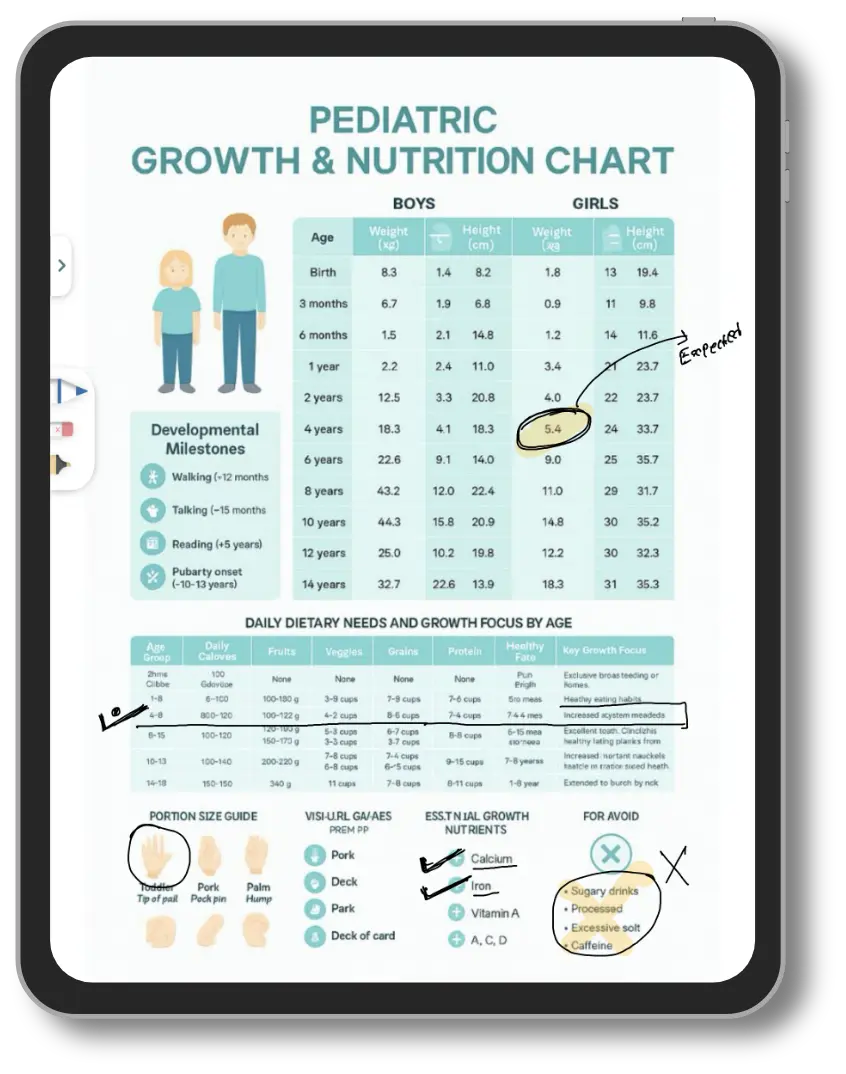
Show growth charts, nutrition guides, and developmental milestones on the tablet. Parents see their child's progress visually — follow-up compliance improves dramatically.
No printed charts needed. No extra cost. Just tap and show.
Built for Pediatric Workflow
Every feature designed around how a paediatrician actually works — fast OPD, vaccination tracking, and parent communication.
Quick prescription writing on tablet — same as paper
Digital vaccination chart with auto-reminders to parents
Growth chart tracking and nutrition guidance images
Show child health education images on tablet for parents
Parent gets Rx on WhatsApp instantly
Complete patient history across all visits
How Lifemaan Handles the Pediatric Workflow
Each step of a pediatric practice maps to a module already built into Lifemaan.
| Pediatric workflow | How Lifemaan handles it |
|---|---|
| Child registration & history | EMR keeps vaccinations, growth data, and past prescriptions in one record across every visit. |
| Immunization tracking | Appointment and reminder module schedules doses against the IAP schedule with WhatsApp parent reminders. |
| Prescriptions & dosing | E-prescription with Speech-to-Rx (22 major Indian languages plus English and Hinglish) — written on tablet, typed, or dictated. |
| Growth & well-baby visits | Structured EMR fields capture anthropometry and milestones, plotted on the tablet during the visit. |
| Pediatric IPD | IPD, bed management, and ICU modules handle inpatient wards and critical care on the same platform. |
| Billing & portable records | GST billing for visits, vaccination packages, and bundles; ABDM compliant, so records link to ABHA. |
How It Works
Three steps to a faster, smarter pediatric practice.
Child Visits Your Clinic
New or returning patient is registered in seconds. Past vaccinations, growth data, and complete history appear instantly.
Write Rx on Tablet in Seconds
Write the prescription on tablet — just like paper. Pick up the pen, write, done. 10 seconds for a typical pediatric Rx.
Auto Vaccination Reminders to Parents
Parent gets Rx on WhatsApp instantly. Vaccination schedule is updated. Auto reminders sent when the next dose is due.
What You Get
Everything a pediatric practice needs — in one platform.
OPD Management
Patient registration, token queue, digital prescriptions, auto billing.
Learn moreTablet Writing
Write prescriptions on tablet like paper. No typing needed.
Learn morePatient Management
Complete patient database with medical history and WhatsApp engagement.
Learn moreBilling & Accounting
Automated billing, GST invoices, payment tracking, and financial reports.
Learn moreWhat Paediatricians Say
“For a paediatrician, vaccination tracking is crucial. Lifemaan sends automatic reminders to parents via WhatsApp. My recall rate has doubled since I started using it.”
Dr. Arpit Viroja
Paediatrician, Sattva Child Care, Rajkot
Lifemaan's pediatric practice software is built for Indian pediatricians. It tracks immunizations against the Indian Academy of Pediatrics (IAP) schedule with WhatsApp parent reminders, plots WHO and IAP growth charts on the tablet during the consultation, computes pediatric drug dose by weight and age automatically, and captures specialty-specific records — APGAR, anthropometry, newborn screening, developmental milestones. Used across 576+ hospitals in India.
Last updated: May 2026
What pediatric software must handle
A pediatrician's day-to-day work is different from a generalist's, and the software has to match. The basics any paediatric practice in India expects: the IAP immunisation schedule with WhatsApp reminders to parents, WHO and IAP growth charts on the tablet during the visit, dose-by-weight calculation built into the prescription, and structured fields for the data points a paediatrician actually records — APGAR scores, anthropometry, developmental milestones, newborn screening results, and mid-parental height.
What this page covers
- 1How Lifemaan handles each of these workflows
- 2Regulations and guidelines (IAP, NNAP, CDSCO) that frame the practice
- 3Package-based billing patterns paediatric practices use
- 4Numbered walkthrough for a vaccination visit
- 5What a busy paediatric Monday looks like on Lifemaan
- 6Adolescent and chronic-care continuity
- 7Pediatric IPD on the same platform
- 8Parent-engagement flow on WhatsApp
Pediatric-Specific Workflows in Lifemaan
Growth Chart Tracking — WHO and IAP Percentiles on the Tablet
Every child's weight, height, and head circumference are plotted automatically against WHO percentile curves and the India IAP growth charts. The pediatrician can show the parent exactly where the child sits — for example, a 9-month head circumference at the 50th percentile against the IAP chart for Indian children — without flipping to a printed chart booklet. Trend visualisation across visits shows growth velocity, not just point values, which is the more meaningful clinical signal.
Immunization Schedule Tracking — IAP Recommended Schedule
The immunization tracker is aligned with the IAP recommended schedule. Each child's profile shows administered doses with batch numbers, upcoming due doses, and the catch-up schedule if the child is behind. Auto-WhatsApp reminders go out to parents ahead of each due dose, which reduces no-show rates and improves the practice's overall immunization coverage. Records are ABDM-linked under the parent's consent.
Pediatric Dose Calculation by Weight and Age
Pediatric dose-by-weight is the single most error-prone calculation in a paper pediatric OPD. Lifemaan's prescription module computes the per-dose value automatically from the child's recorded weight and the standard mg/kg range for the chosen medication. The pediatrician sees the computed value as they write the prescription on the tablet — they can accept it as is, or override and document the reason. This is built into the prescription writing flow itself, not a separate calculator that has to be opened.
Pediatric Terminology and Data Fields Built In
Pediatric records carry data fields that a generalist HMS does not have. Lifemaan ships these as first-class fields:
Mid-parental height calculation
Projected adult height computed from father's and mother's height, used to interpret a child's current trajectory.
APGAR scores at delivery
The 1-minute and 5-minute APGAR captured against the newborn record so the longitudinal pediatric file starts with the right baseline.
Anthropometric measurements
Head circumference, mid-upper arm circumference (MUAC), chest circumference, and length-for-age captured per visit and plotted against percentile curves.
Developmental milestone tracking
Structured fields for gross motor, fine motor, language, and social milestones at each well-baby visit, so delays are caught early.
Newborn screening test results
Hypothyroidism, G6PD, hemoglobinopathy, and other screening results attached to the newborn record from day one.
Regulations and Clinical Guidelines Supported
Indian Academy of Pediatrics (IAP) immunization schedule
Lifemaan's immunization tracker uses the current IAP recommended schedule as its default reference. Updates to the schedule are reflected in the tracker so the pediatrician does not have to re-configure individual child profiles.
National Newborn Action Plan (NNAP)
Newborn records — APGAR, anthropometry, breastfeeding initiation, kangaroo mother care notes, and screening test results — are captured in structured fields that align with the NNAP data collection pattern.
CDSCO guidelines for pediatric drug dosing
The dose-by-weight calculator references standard pediatric dosing ranges in line with CDSCO and IAP guidance. The pediatrician can override the computed dose with documented justification when clinical judgement calls for it.
Pediatric Billing Patterns
Pediatric practices bill differently from general OPD practices. The common patterns Lifemaan supports out of the box:
Vaccination packages
Bundled pricing for age windows (e.g. 0–1 year package, 1–5 year package) rather than per-shot pricing.
Well-baby visit pricing
Visit packages that include growth check, milestone review, and any in-visit immunization.
Immunization bundle billing
Multiple vaccines administered in one visit billed as a bundle with the appropriate GST applied per line.
Newborn package billing
Bundled charges for the first 1–2 weeks of newborn follow-up.
All of these flow through Lifemaan's GST-compliant billing module, with one click generating the tax invoice for the parent.
How a Pediatrician Logs a Vaccination Visit in Lifemaan
- 1.Open patient record. The child's profile loads with past visits, the full immunization history with batch numbers, the growth chart with the current and previous percentile positions, developmental milestone status, and any anthropometric measurements from previous visits. The pediatrician sees the full longitudinal picture before the parent even sits down.
- 2.Verify immunization status against the IAP schedule. Lifemaan flags which doses are due today, which are upcoming in the next window, and any catch-up doses if the child is behind. The catch-up logic respects the IAP guidance for minimum intervals between doses, so the consultant does not have to compute the catch-up plan manually.
- 3.Select vaccine and batch number. The pediatrician picks the vaccine from the IAP-aligned list and enters the batch number from the vial — the batch traceability matters in case of a later recall or AEFI investigation. The dose is logged against the child's longitudinal record with the date, the batch, and the site of administration.
- 4.Parent reminder triggers. Lifemaan automatically schedules the WhatsApp reminder for the next due dose per the IAP schedule. The practice does not have to maintain a parallel reminder list; the schedule is computed from today's dose and the IAP recommended interval. The parent gets the reminder ahead of the next due date with the vaccine name and the booking link.
- 5.Generate GST invoice. One click produces the GST-compliant invoice for the vaccination — billed against the relevant package (well-baby visit, 0–1 year vaccination package, or stand-alone shot) with the correct GST applied. The invoice goes to the parent on WhatsApp along with the updated immunization card and the next due date.
What a Busy Pediatric Monday Looks Like on Lifemaan
A pediatric practice in a metro city typically sees a heavy Monday OPD — weekend illnesses, follow-up visits, and vaccination appointments concentrated into one day. The patterns that matter on a paediatric Monday are the ones the tablet workflow handles natively.
A toddler with a fever comes in
The parents do not remember the exact paracetamol dose given last night, but the previous prescription is in the file and the dose-by-weight calculation shows the current safe range based on the updated weight.
A well-baby visit at 6 months
The growth chart is plotted live on the tablet and shown to the parents, the immunization due today is the OPV/IPV booster per the IAP schedule, and the reminder for the 9-month visit is scheduled before the family has even left the room.
A newborn comes in for the first post-discharge visit
The pediatric consultant opens the file and sees the APGAR scores from delivery, the birth anthropometry, the newborn screening results that came back from the lab, and the labour course as documented by the gynaecology team. The conversation with the parents is grounded in data the consultant did not have to recreate.
A school-age child comes in for a recurrent issue
The consultant sees the previous three visits chronologically, the growth trend across the year, and the family history captured at the first visit.
The consultation is faster because the consultant is not rebuilding context; the consultation is also better because the context they are working from is complete.
What Indian Pediatric Practices Need From Their Software
Pediatric practices in Indian metros and tier-2 cities have a distinctive operational shape. The patient mix is weighted toward well-baby visits, scheduled vaccinations, recurrent acute illnesses (URI, GI, viral fever), and a smaller share of chronic-care follow-ups. Parents tend to be involved in the consultation in a way that adult consultations rarely see — they want to understand the growth chart, see the immunization schedule clearly, hear what the recommended next step is, and have a documented record to share with grandparents and other relatives who are usually consulted before any major decision.
Lifemaan is built around these patterns:
The growth chart is shown on the tablet so the parents see visually where the child sits.
The immunization schedule is automatically managed so the parents do not have to keep paper booklets.
The prescription goes to the registered WhatsApp number so the grandparents who are at home — and who often dispense the medicine at the right time — see the same prescription the doctor wrote.
The follow-up reminder for the next due vaccine is automatic so the practice does not have to run a manual recall list.
For pediatric practices that also run paediatric IPD (typically a small inpatient ward attached to the OPD), the same Lifemaan tenant handles the admission flow with the Visual Bed Board, the medication administration tracking, and the discharge summary generation — without a separate tool for the inpatient side.
What to Look For When Evaluating Pediatric Practice Software
A pediatrician evaluating practice software is usually evaluating against three failure modes:
Generic HMS tools that have a pediatric module bolted on as an afterthought — dose-by-weight is a separate calculator instead of being built into the prescription flow, immunization tracking does not align with the IAP schedule, growth charts are not visualised during the consultation.
Scheduling-and-billing-only tools that handle appointments and invoices but do not actually replace the paper prescription — the consultant is still writing on paper after onboarding.
EMR-only tools that handle clinical records but do not integrate billing or WhatsApp delivery, so the practice ends up running three systems.
Handle the pediatric-specific clinical workflow (dose-by-weight, IAP immunization, growth charts, anthropometry, milestones), the consultation workflow (tablet writing and Speech-to-Rx in Indian languages), and the operational workflow (appointments, billing, WhatsApp delivery, ABDM-linked records) on one tenant. The pediatrician is not choosing between three trade-offs; the same product covers all three.
Parent Engagement on WhatsApp Without a Separate App
Indian parents rarely download a paediatric clinic app. They use WhatsApp constantly and check it multiple times a day. A practice that pushes communication through a portal that requires the parent to sign in ends up with low engagement; a practice that uses WhatsApp meets the parents where they already are. Lifemaan's parent engagement flow runs on the patient's registered WhatsApp number from registration onward, with no app download required.
The prescription written on the tablet goes to WhatsApp the moment the consultant saves it.
Appointment reminders go out the evening before the scheduled visit.
The next-due vaccination reminder goes out per the IAP schedule.
Growth chart updates after a well-baby visit can be shared as part of the consultation summary.
Recall reminders for chronic paediatric conditions — asthma controller review, allergy follow-up, diabetes management — go out per the consultant's preferred interval.
The grandparents at home who dispense the medicine see the same prescription the consultant wrote, which reduces dosing errors that come from verbal handoffs within the family.
Siblings on the Same File
One more practical pattern that matters in a pediatric practice: parents often have older children and younger children in the same family on the same Lifemaan file. The siblings are linked so the family's collective vaccination schedule, growth history, and consultation pattern is visible together. When the parent comes in with the younger child for a sick visit, the consultant can also check whether the older child's next dose is coming up and remind the parent at the same visit — a small operational efficiency that compounds across the practice and quietly improves overall immunisation coverage in the patient base.
Vaccine Batch Traceability and Multi-Language Reminders
Two operational details worth highlighting for paediatric practices.
Vaccine batch traceability
Every administered dose carries the batch number captured at the time of administration, so if a vaccine recall or AEFI (Adverse Event Following Immunisation) investigation arises later, the practice can identify which children received which batch without a paper register hunt.
Multi-language parent communication
WhatsApp reminders and prescriptions go out in the language the consultant wrote or dictated in, across all 22 major Indian languages plus English and Hinglish — so the parents receive instructions in a script and language they actually read fluently, which matters in paediatrics where the parent dispensing the medicine is often a grandparent reading from the WhatsApp message.
Related Reading
- Hospital Management Software — full HMS view if the practice operates within a hospital setting.
- Clinic Management Software — the clinic-scoped view for solo and small group practices.
- Speech-to-Rx — dictate pediatric prescriptions in all 22 major Indian languages plus English and Hinglish.
- Tablet Writing — write prescriptions on a tablet with a stylus.
- For Gynaecologists — antenatal-to-newborn handoff sits at the gynec-pediatric boundary.
- ABDM Compliance for Hospitals — how ABHA-linked records keep a child's immunisation and growth history portable across providers.
Adolescent Care and Chronic Pediatric Conditions
A pediatric practice does not stop at infancy. The same patient who came in for newborn screening at two weeks comes back as a toddler for vaccination visits, as a school-age child for acute illnesses, and as an adolescent for puberty-related concerns and chronic conditions like asthma, allergic rhinitis, or pediatric diabetes. The Lifemaan patient file preserves the full longitudinal record across these life stages. The pediatrician sees the growth trajectory from birth, the immunization history, the previous prescriptions, and the family history captured at the first visit — without re-asking the parents at each subsequent visit.
For chronic conditions, the longitudinal view is the clinical value. A pediatric asthma patient's visit frequency, peak flow trends, exacerbation history, and current step-up or step-down therapy position are all visible from the same patient file. The pediatrician makes decisions against the trend rather than against the single visit, which is what chronic-disease management actually requires. Vaccination boosters that come due in later childhood and adolescence — Td, HPV — are scheduled and tracked the same way the early-childhood schedule is handled.
Pediatric IPD on the Same Platform
Many pediatric practices in India run a small inpatient ward alongside the OPD — a daycare bed for jaundice phototherapy, an observation bed for moderate dehydration, or a step-down ward for post-discharge paediatric admissions.
The same Lifemaan tenant that runs the OPD handles the inpatient flow. The Visual Bed Board shows the paediatric ward's occupancy in real time, the dose-by-weight calculation that applies in OPD also applies in IPD, the nursing charting for fluids and feeds is captured against the patient file, and the discharge summary is generated from the actual treatment record. There is no separate tool for the inpatient side; the pediatrician and the paediatric nursing team work in the same environment for both OPD and IPD.
ICU-level monitoring
For pediatric admissions that need ICU-level monitoring — paediatric ventilator support, neonatal ICU stays, post-surgical observation — the ICU module handles the structured monitoring with ventilator sheets, infusion pump tracking, hourly vitals, and the relevant scoring scales.
Consolidated discharge billing
Charges flow into the consolidated patient bill at discharge with the appropriate paediatric package or per-day rate applied.
ABDM, ABHA, and the Pediatric Patient Record
Pediatric records are unusually long-lived: the child's immunisation record, growth history, developmental milestones, and any chronic-care history accumulate over years and follow the child through school, into adolescence, and beyond. The value of an ABDM-linked record in paediatrics is most visible at the moments the family changes paediatricians — relocating to a new city, moving to a different clinic for convenience, or seeking a specialist opinion. A complete digital record that can be shared through ABDM under the parent's consent means the new consultant starts with the full longitudinal picture rather than rebuilding it from the parents' memory.
Lifemaan captures the child's ABHA at registration (or any subsequent visit) and links the records to it.
Prescriptions, immunisation records, growth chart data, and consultation notes are structured in the ABDM-compatible format.
The consent flow is parent-driven through the parent's ABHA app, with the clinic seeing the consent state before any external sharing happens.
For paediatricians whose patient base extends across urban and metro families that frequently relocate for work, ABDM compliance is increasingly part of what families expect from their child's primary clinic.
Pediatric Practice — Frequently Asked Questions
Pediatric Practice Economics on Lifemaan
A pediatric practice's economics are different from an adult specialty's. Visits are shorter and more frequent, vaccination revenue is a meaningful share of the overall mix, package pricing dominates over per-visit billing, and parents expect a friction-free billing experience because they are juggling work, school, and the child. A billing flow that asks the parent to wait ten minutes at the counter while the staff reconciles the visit cost against the package balance is the kind of friction that loses patients to a competitor practice quietly.
Lifemaan's pediatric billing handles vaccination packages, well-baby visit packages, immunization bundles, and newborn package billing as first-class items. When a child consumes a vaccine that is part of a 0–1 year vaccination package, the package balance updates automatically; the parent sees one consolidated invoice without per-shot reconciliation. For paid visits outside a package, the GST-compliant invoice generates with one click and goes to the parent's WhatsApp along with the prescription and the next vaccine reminder.
For the practice owner — usually a pediatrician running the business as well as the clinical practice — the dashboard shows the day's consultations, vaccinations administered, package balances active, collections by mode, and outstanding payments. Recall rate for due vaccinations is visible, which is the practice-economics number that matters most for paediatric retention.
See Lifemaan in Action
15-minute personalized walkthrough. We show you exactly how it works for your practice.
Or reach us directly: +91 90237 53539 · WhatsApp