
ABDM Compliance for Hospitals (2026 Guide)
ABDM compliance means your hospital or clinic is registered on the Health Facility Registry (HFR), can create and link ABHA IDs at registration, and shares records in the consent-based, FHIR-compliant format ABDM requires. Most of this work happens inside your hospital management software — an ABDM compliant HMS handles HFR-linked workflows, ABHA creation, and consent so staff follow a normal flow. This guide explains exactly what ABDM compliance requires of a facility and how to get there.
Last updated: June 2026
India's healthcare system runs on paper — referral slips, discharge summaries, handwritten prescriptions, and lab reports stuffed into plastic folders that patients carry from one doctor to the next. ABDM was designed to change that, not by mandating a single software vendor, but by building shared infrastructure that any hospital, clinic, or health app can plug into.
This guide is written for hospital and clinic operators: a quick plain-language definition of ABDM, then the part that matters to you — what compliance actually requires at the facility level (HFR registration, ABHA creation, consent, FHIR records), and how an ABDM compliant HMS handles most of it for you.
What Is ABDM?
ABDM — Ayushman Bharat Digital Mission — is a Government of India programme managed by the National Health Authority (NHA). Its goal is to create a national digital health ecosystem in which health records are interoperable, patients can access their own data, and clinicians can retrieve a patient's history regardless of where earlier care was delivered.
ABDM is not a product you buy. It is a set of registries, standards, and protocols that software systems — including hospital management systems — can integrate with. Think of it as the UPI of healthcare: the rails are public, the apps built on top vary.
The mission was announced under the National Digital Health Mission in 2020 and progressively expanded. ABDM operates under the Digital Personal Data Protection framework and gives patients explicit consent controls over who can access their linked health records.
The Four Core Building Blocks of ABDM
Understanding ABDM becomes straightforward once you look at its four main components. Each solves a specific problem.
| ABDM Component | What It Is | Why It Matters to Your Hospital |
|---|---|---|
| ABHA (Ayushman Bharat Health Account) | A unique 14-digit health ID for every Indian citizen | Lets you tag patient records to a persistent identity — no more duplicate files for the same patient returning under a different name spelling |
| Healthcare Professionals Registry (HPR) | A national registry of doctors and allied health professionals | Your registered doctors get a verified digital identity used for signing prescriptions and discharge notes electronically |
| Health Facility Registry (HFR) | A national registry of hospitals, clinics, labs, and pharmacies | Your facility gets an official ABDM identity; required for participating in record exchange and future scheme linkages |
| Unified Health Interface / Health Records Exchange | The consent-based system that lets patients share records between facilities | Patients can pull their records from your HMS into another provider's system — or vice versa — with a single consent tap |
ABHA — The Patient's Health ID
ABHA is the most visible part of ABDM for a patient. It is a 14-digit number linked to a person's Aadhaar or mobile number. Once created, a patient can link any health record — OPD visit, discharge summary, lab report, prescription — to their ABHA ID.
For a hospital, this means:
- You can create an ABHA ID at registration if the patient does not already have one.
- Returning patients can share their ABHA ID and give consent for you to pull previous records.
- Discharge summaries and prescriptions you generate can be pushed to the patient's ABHA-linked health locker.
ABHA does not automatically share data with anyone. The patient controls consent at every step.
HPR — Healthcare Professionals Registry
HPR is the national database of verified doctors, nurses, paramedics, and other licensed health professionals. Registration in HPR gives a healthcare professional a unique HPR ID that can be used to digitally sign clinical documents.
For clinic and hospital operators, practical relevance:
- Doctors on your staff should ideally be HPR-registered so their digital prescriptions carry verified credentials.
- HPR registration is separate from MCI/State Medical Council registration but cross-references existing professional licenses.
HFR — Health Facility Registry
HFR is the directory of all health facilities participating in the ABDM ecosystem — government hospitals, private hospitals, clinics, diagnostic labs, and pharmacies. Registering your facility on HFR gives it an official ABDM facility ID.
HFR registration is generally the first step for any facility wanting to participate in ABDM-linked programmes, including certain Ayushman Bharat empanelment processes.
Unified Health Interface and Record Exchange
The Unified Health Interface (UHI) and the broader health records exchange layer are the "plumbing" that makes ABDM useful. Once a patient has an ABHA ID and a facility is HFR-registered, the patient can:
- Give consent for records from Facility A to be shared with Facility B.
- Store records in a Personal Health Record (PHR) app or health locker.
- Revoke consent at any time.
This is the layer that makes ABDM genuinely different from earlier e-health initiatives: the patient sits at the centre of their own data, rather than records sitting silently inside one hospital's server.
What Does ABDM Compliance Practically Require?
"ABDM compliance" is a term used loosely in the market. Here is what it actually involves at a facility level:
1. HFR Registration
Register your hospital or clinic on the Health Facility Registry at facility.abdm.gov.in. This requires basic facility information — type, ownership, specialties, address — and links to your existing government registrations where applicable.
2. ABHA Creation at Registration
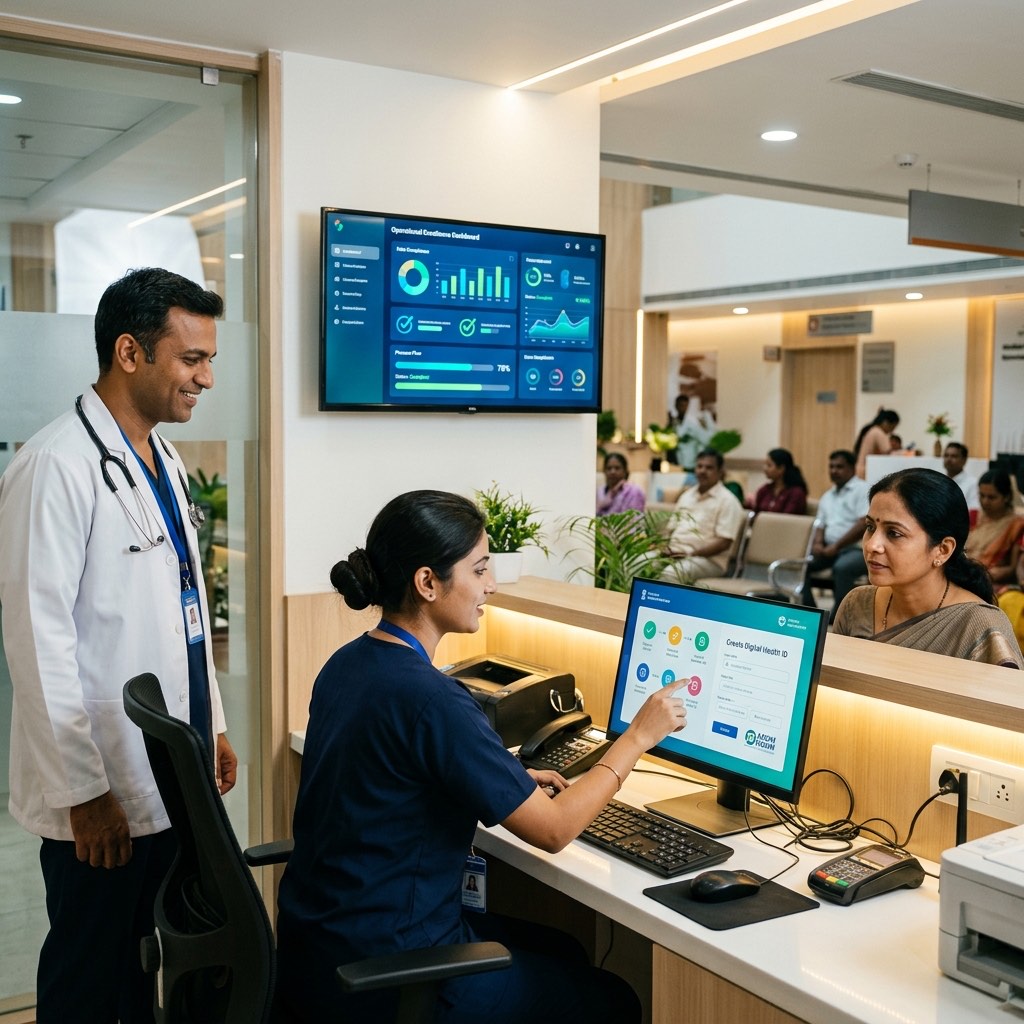
Your HMS or front-desk software should be able to create a new ABHA ID for patients who do not have one, or verify and link an existing ABHA ID. This is typically done at OPD registration.
3. Linking Clinical Records to ABHA
When your HMS generates a prescription, discharge summary, or lab report, an ABDM compliant system can push that record as a structured FHIR document to the patient's ABHA-linked health locker — provided the patient has consented.
4. Consent Management
Your HMS must support the ABDM consent flow — prompting patients before records are shared, logging consent grants and revocations, and not sharing records absent a valid consent artefact.
5. FHIR-Compliant Record Formats
ABDM uses HL7 FHIR (Fast Healthcare Interoperability Resources) as its standard for structured clinical data. An ABDM-integrated HMS should generate records in FHIR-compatible formats rather than proprietary blobs.
Is ABDM Participation Mandatory?
The short answer is: it depends on your context. For facilities empanelled under Ayushman Bharat PM-JAY and certain state health schemes, digital compliance requirements have been progressively tightened. For private facilities not under those schemes, ABDM participation has been strongly encouraged but not universally mandated as of mid-2026. Government guidance has moved in a clear direction — towards making ABDM integration a condition for various government health programmes — so facilities that delay integration will find themselves needing to catch up. It is safer to treat ABDM compliance as a near-term operational requirement rather than a distant future concern.
How an ABDM Compliant HMS Supports Compliance
The practical work of ABDM integration happens inside your hospital management software, not at the front desk manually. An ABDM compliant HMS handles:
- ABHA creation and verification at OPD registration without a separate workflow
- Automatic record structuring in FHIR format when generating prescriptions and discharge summaries
- Consent prompts embedded in the patient journey
- Record push to the patient's health locker after a visit or discharge
Lifemaan, used by 576+ hospitals and clinics across India, is built with ABDM compliance as part of its core EMR and OPD management workflows. Its modules — from appointment and queue management to IPD, billing, and discharge summaries — are designed so ABHA linking fits into the existing registration and clinical flow rather than sitting as a bolt-on.
For facilities evaluating options, the key questions to ask any HMS vendor are: Does your system create and verify ABHA IDs natively? Are discharge summaries generated in FHIR format? How does consent management work in your OPD flow?
How Lifemaan Handles ABDM Compliance for You
Lifemaan is ABDM compliant — certified by the National Health Authority across Milestones M1, M2 and M3. Everything described above — ABHA creation and verification (M1), consent-based sharing of FHIR records (M2), and retrieval of records from other facilities (M3) — is built into the software your staff already use.
What that means for your hospital in practice:
- ABHA creation happens at registration. Your front desk creates or verifies the patient's ABHA in the same screen where they already enter patient details. No separate portal, no second login.
- Records link automatically. Consultation notes, prescriptions and discharge summaries written in Lifemaan are linked to the patient's ABHA as they are created — not batched, not re-entered.
- Consent is handled inside the workflow. Staff are prompted at the point it is required rather than managing consent as separate paperwork.
- Records from other facilities come to you. Because Lifemaan is certified at M3, a patient's prior records held elsewhere can be requested and viewed in Lifemaan on their consent — useful at referral and revisit.
- No integration project on your side. The certification is ours. Your hospital still completes its own HFR registration — Lifemaan's team walks you through it during onboarding.
Quick Summary: ABDM at a Glance
- ABDM is India's national digital health infrastructure — not a product, but shared rails.
- ABHA is the patient's unique health ID — 14 digits, consent-controlled.
- HPR verifies your doctors digitally; HFR registers your facility officially.
- Record exchange is consent-based; patients own their data.
- Practical compliance starts with HFR registration, ABHA creation at OPD, and using an HMS that generates FHIR-structured records.
- An ABDM compliant hospital management system handles most of the technical complexity — the hospital's job is to use it correctly.
If your facility has not yet registered on HFR or evaluated whether your HMS supports ABHA workflows, that is a practical starting point. Book a free demo with Lifemaan to see how ABHA creation and ABDM workflows fit into a live OPD registration flow.
Frequently Asked Questions
Want to see Lifemaan in action?
Schedule a free demo for your hospital or clinic. See how easy the switch to digital can be.
Book Free Demo