Advantages of Hospital Management System
A hospital management system (HMS) reduces manual errors, tightens revenue capture, and shortens patient wait times — whether you run a single clinic or a multi-specialty chain. The benefits scale with hospital size, but the core gains — cleaner data, faster workflows, and better compliance — apply universally. This post maps each advantage to who gains the most and what the outcome looks like in practice.
Last updated: June 2026
Why Hospital Management Systems Have Moved from "Nice to Have" to Necessary
Indian hospitals and clinics operate in a tightening environment: ABDM mandates are rolling out, NABH accreditation scrutiny has increased, GST compliance on healthcare billing is non-negotiable, and patients increasingly expect digital records and shorter queues. Parallel to this, staff shortages mean every manual step — hand-copied prescriptions, paper registers, verbal billing instructions — carries a real cost in time and accuracy.
A hospital management system addresses these pressures not by replacing clinical judgment, but by digitising the administrative and operational layer that surrounds it. The result is that doctors spend more time on care, administrators catch revenue before it leaks, and patients experience a measurably faster journey from registration to discharge.
Before we map the advantages, it helps to understand what these systems actually cover. For a detailed module-by-module breakdown, see what modules an HMS includes.
The Core Advantages of an HMS — Mapped by Facility Type
No two hospitals are identical. A 10-bed clinic has different pain points from a 150-bed district hospital or a multi-branch chain. The table below maps each key advantage to the facility type that typically feels it most acutely, along with the expected operational outcome.
| Advantage | Who Benefits Most | Practical Outcome |
|---|---|---|
| Digital OPD registration & queue management | All sizes, especially high-footfall clinics | Shorter wait times, fewer reception errors |
| GST-compliant billing & itemised invoices | Mid-size hospitals, chains | Less billing leakage, audit-ready records |
| EMR / EHR with structured prescription data | All sizes | Fewer transcription errors, faster referrals |
| ABDM compliant digital health records | All sizes (compliance-driven) | ABHA linking, HFR registration, regulatory readiness |
| Pharmacy & inventory integration | Mid-size and above | Reduced stockouts, lower pilferage |
| IPD + bed management | Multi-specialty hospitals | Higher bed utilisation, faster discharge |
| Consolidated multi-branch reporting | Chains and groups | Single-view performance data across locations |
| Automated discharge summaries | Mid-size hospitals, ICU-heavy | Faster patient exit, reduced clinician documentation load |
Advantage 1: Faster OPD and Shorter Patient Wait Times
For most outpatient facilities, the bottleneck is not clinical — it is administrative. Registration, token assignment, doctor allocation, prescription printing, and payment collection each involve a hand-off that can stall the queue.
An OPD management software module digitalises every step: walk-in or appointment-based registration feeds directly into the doctor's worklist, prescriptions are generated on-screen (or dictated), and billing is triggered the moment the consultation ends. The cumulative effect is that each patient's visit cycle becomes shorter — which matters both for patient satisfaction and for the total number of patients a facility can serve in a day.
For clinics where the doctor IS the product, reducing administrative friction around consultations is among the highest-impact improvements available.
Advantage 2: Tighter Revenue Capture and Less Billing Leakage
Billing leakage — services rendered but not billed, or billed incorrectly — is a persistent problem in manual hospital workflows. Common causes include verbal service orders that never reach billing, unbilled pharmacy dispensing, and rate mismatches between departments.
An HMS closes these gaps by connecting the clinical workflow to the billing engine. When a doctor orders a lab test or a nurse records a procedure in the patient's file, that order is visible to the billing team in real time. Nothing falls through between floors or shifts.
For mid-size hospitals managing IPD patients over multiple days, this integration between IPD modules and billing is where the financial impact is most pronounced. GST-compliant, itemised invoices also reduce disputes at discharge and make TPA/insurance claims cleaner.
Advantage 3: Reduction in Manual Errors Across Clinical and Admin Functions
Handwritten prescriptions are notoriously prone to misreading. Paper registers are duplicated, lost, or updated inconsistently. Verbal bed-allocation instructions lead to double-booking. These are not failures of individual staff — they are structural vulnerabilities of paper-based systems.
An EMR/EHR software module brings structured data entry to prescriptions, lab results, vitals, and clinical notes. Drugs are selected from a validated formulary, dosages have guards, and the record is immediately available to every authorised clinician — including those consulting remotely.
For facilities pursuing NABH accreditation, a structured electronic record is increasingly a baseline expectation, not an optional feature. The audit trail an HMS generates — who entered what, when, and with what authorisation — directly supports accreditation documentation.
Advantage 4: ABDM Compliance and Future-Proofing
The Ayushman Bharat Digital Mission (ABDM) is gradually becoming a compliance reality for hospitals and clinics across India. This includes Health Facility Registry (HFR) registration, ABHA (Health Account) linking for patients, and interoperable digital health records.
Facilities still running on paper or on non-ABDM compliant software will face a migration burden as mandates tighten. An ABDM compliant HMS handles the technical layer — FHIR-compliant records, ABHA ID linking at registration, consent-based sharing — so that the facility's administrative team does not need to understand the underlying architecture.
For a plain-English explanation of what ABDM actually requires, see what is ABDM.
Advantage 5: Better Staff Productivity Without Adding Headcount
One of the least-discussed benefits of an HMS is the reduction in low-value administrative work that consumes nursing, reception, and billing staff time. When records are digital and integrated, staff spend less time on activities like:
- Re-entering data from one register to another
- Locating patient files from physical storage
- Manually calculating bills from department slips
- Preparing reports by collating spreadsheets
This matters particularly for facilities where headcount is constrained. An HMS does not reduce the need for skilled clinical staff — but it does free existing administrative staff to handle higher-value tasks, or to handle higher patient volumes with the same team size.
Advantage 6: Data-Driven Decision Making for Hospital Administrators
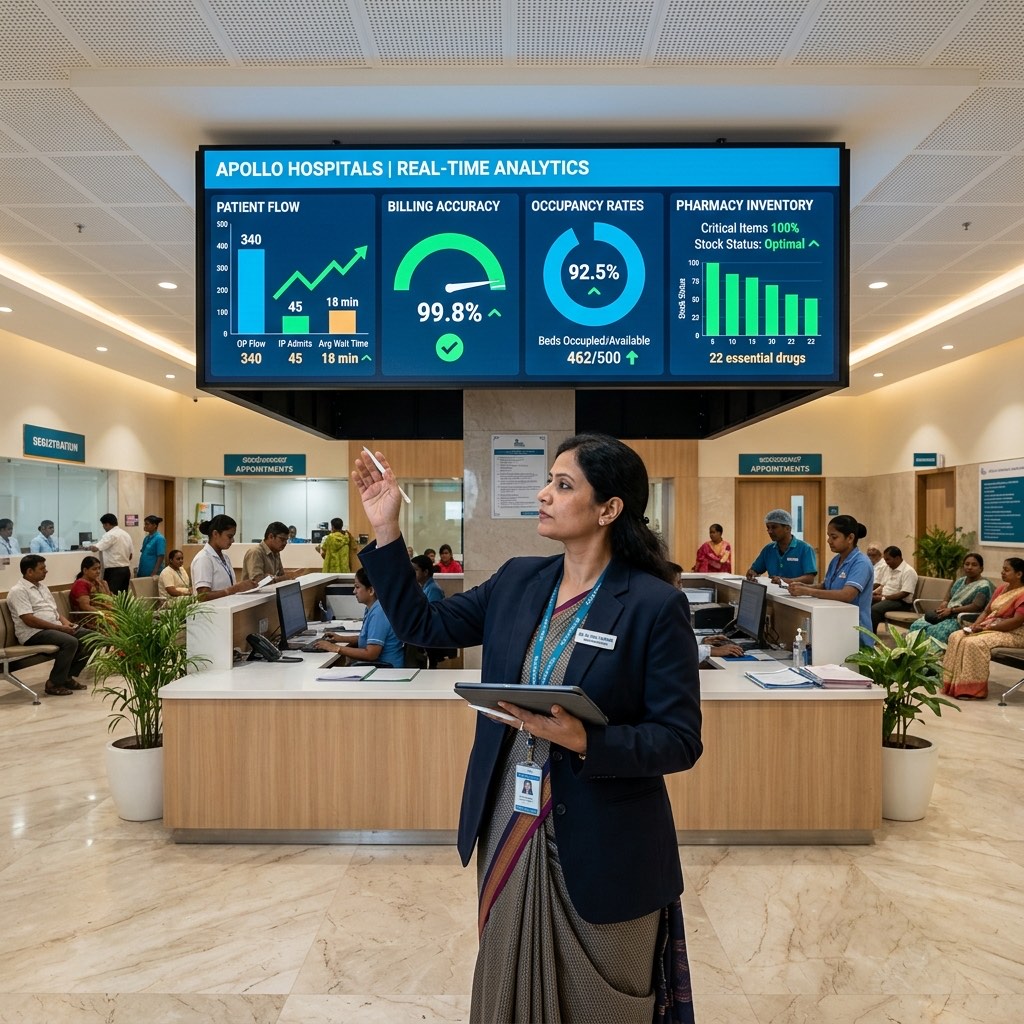
A paper-based or fragmented-software hospital generates data — but it cannot surface it usefully. An administrator who wants to know which OPD speciality is running over capacity, which ward has the longest average length of stay, or which pharmacy items have the highest stockout frequency, typically cannot get that answer without a manual audit.
An integrated HMS makes this data available through dashboards and reports. This is the foundation of operational decision-making: bed allocation, staff scheduling, supplier negotiations, and expansion planning all improve when they are based on actual throughput data rather than intuition.
For multi-branch groups, consolidated reporting across locations — comparing performance, identifying outliers, replicating what works — becomes possible only when all branches are on a common system.
How Benefits Scale Across Facility Types
Small Clinics and Single-Specialty Practices
For a solo practitioner or a small clinic, the biggest gains are in OPD workflow speed, prescription accuracy, and basic billing. A lightweight clinic management software module with appointment scheduling and EMR is typically sufficient. The barrier to adoption is low; the impact on daily workflow is immediate.
Mid-Size Hospitals (30–200 beds)
Mid-size hospitals gain most from IPD management, GST billing, pharmacy integration, and NABH/ABDM compliance. The complexity of managing inpatients across multiple departments — with admissions, transfers, procedures, and discharge all needing coordination — is where an HMS earns its keep most visibly.
Multi-Specialty Chains and Groups
For groups managing multiple locations, the strategic advantage is unified data. A chain where each branch runs on a different system (or no system) cannot benchmark, cannot centralise procurement, and cannot offer consistent patient records across locations. An hospital ERP approach — single platform, multi-branch — removes that fragmentation.
The Flip Side: What to Watch For
Adopting an HMS brings real advantages, but the transition itself has challenges: staff resistance, data migration from legacy systems, training timelines, and integration with existing equipment. Understanding these before you sign a contract makes for a more realistic implementation plan. We cover these in detail in challenges in hospital management.
Similarly, pricing varies significantly by module depth, hospital size, and deployment model (cloud vs on-premise). For a transparent comparison, see hospital management software pricing in India.
A Note on Choosing the Right HMS
Not every HMS fits every facility. A 10-bed clinic does not need an ICU module; a 200-bed hospital cannot function on a basic appointment scheduler. Matching the software to your workflows — rather than retrofitting your workflows to the software — is the most important decision in the selection process. The how to choose hospital management software guide walks through this evaluation in detail.
Lifemaan is an HMS built for Indian hospitals and clinics, with modules covering OPD, IPD, ICU, bed management, GST-compliant billing, pharmacy, EMR/EHR, and ABDM integration. It includes AI-powered features like handwriting-to-digital record conversion on tablets and Speech-to-Rx (supporting 22 major Indian languages plus English and Hinglish) — tools that reduce documentation time for clinicians without changing how they practise. As of mid-2026, 576+ hospitals and clinics across India are on the platform.
If you want to see how Lifemaan fits your specific facility type, book a free demo — no commitment, facility-specific walkthrough.
Frequently Asked Questions
Want to see Lifemaan in action?
Schedule a free demo for your hospital or clinic. See how easy the switch to digital can be.
Book Free Demo