Hospital Information System — Digitize Every Department
Free demo. No card needed. We call within 4 hours.
A Hospital Information System (HIS) connects every department in a hospital — clinical, administrative, and financial — under one platform. Lifemaan's HIS covers OPD, IPD, ICU, pharmacy, billing, EMR, digital tablet and Speech-to-Rx prescriptions, auto-generated discharge summaries, and ABDM/ABHA integration. Used across 576+ hospitals in India.
Last updated: May 2026
What Sets Lifemaan Apart
A hospital information system only pays off when every department actually uses it. Lifemaan is built around the reasons Indian hospitals adopt — or abandon — an HIS.
Write like paper, go digital instantly
Doctors write on a tablet exactly as they would on paper and it is digitised in seconds — no typing and no templates to learn.
A voice scribe built into the record
Speech-to-Rx dictates prescriptions and clinical notes in 22 major Indian languages plus English and Hinglish, natively inside the EMR — not a separate app.
One connected platform
OPD and queue, GST billing, EMR, pharmacy (standalone retail and hospital-linked), hospital CRM, and inventory and asset management all read the same patient file.
Built in India, for Indian hospitals
An AI-powered hospital management system founded in Surat in April 2021, designed for Indian small, mid-size, and growing hospitals and clinics.
Proven at scale
576+ hospitals and clinics across India run on Lifemaan as of 2026.
Lifemaan by the numbers
- As of 2026, 576+ hospitals and clinics across India run on Lifemaan. (Source: Lifemaan)
- Doctors have digitised 12,00,000+ patient records on the Lifemaan platform. (Source: Lifemaan)
- Lifemaan has supported care for 5,00,000+ patients across India. (Source: Lifemaan)
What Is a Hospital Information System?
A Hospital Information System (HIS) is a single integrated platform that captures and connects every piece of information a hospital generates — clinical, administrative, and financial. It replaces the patchwork of paper registers, standalone billing tools, separate pharmacy stock notebooks, and dictation-typed discharge summaries with one system where the data flows end-to-end.
A modern HIS spans OPD management, IPD admissions and ward operations, ICU charting, pharmacy stock and dispensing, GST and insurance billing, EMR for clinical records, digital prescriptions, lab and imaging order management, and reporting. The defining characteristic of an HIS — as opposed to a single-function tool — is that the same patient file is visible to every authorised user across every department.
For Indian hospitals, an HIS also means ABDM-linked records, GST-compliant billing, TPA workflows, and documentation patterns aligned with NABH chapters. Lifemaan's HIS is built specifically for these requirements.
How Is HIS Different from HMS?
The terms HIS, HMS, and EMR are often used interchangeably, but they have meaningful distinctions:
| Aspect | HIS | HMS | EMR |
|---|---|---|---|
| Scope | All hospital info — clinical + admin + financial | Operational management | Clinical records only |
| Users | Whole hospital | Admin + clinical | Doctors + nurses |
| Typical modules | OPD, IPD, ICU, pharmacy, billing, EMR | OPD, IPD, billing, pharmacy | Patient records, prescriptions, lab results |
In practice, most modern platforms — including Lifemaan — span what people call both HIS and HMS. The HIS framing matters when hospitals want a single platform that handles every department under one roof, rather than separate tools wired together. EMR is a subset — the clinical records portion — and is one module inside the broader HIS. If you are still mapping the terminology, our explainer on what a hospital management system is breaks down how these systems fit together, and our roundup of the best hospital management software in India compares the leading platforms side by side. On the financial and administrative side, the HIS is backed by hospital ERP software that unifies billing, inventory, pharmacy, and finance.
Looking for something specific?
Most hospitals come to us with one problem first. Start there — you can see the rest in the demo.
Key Modules in Lifemaan's HIS
Lifemaan's HIS ships with the modules an Indian hospital actually needs — all on one tenant, all reading the same patient file.
OPD Management
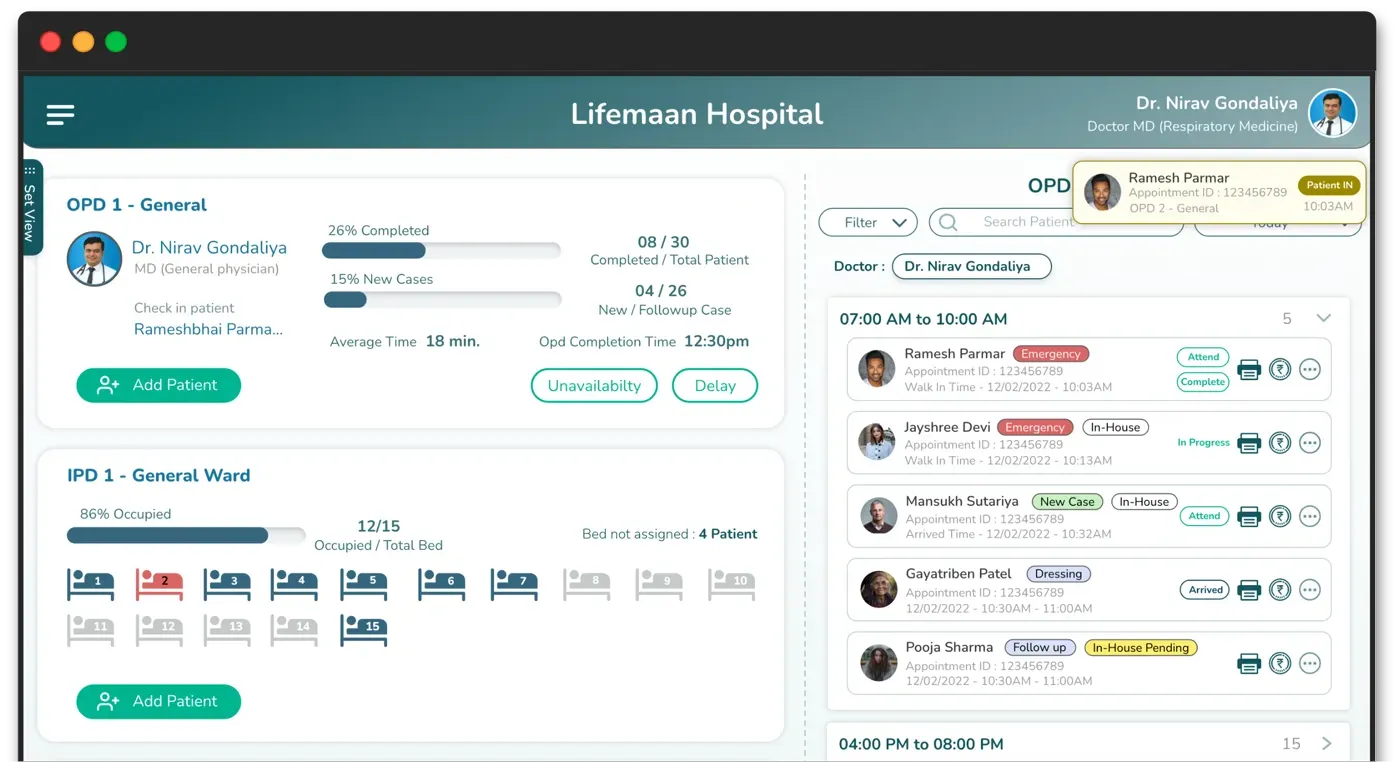
The OPD module is the front door of the HIS. It runs patient queues, appointments, and consultations. Digital prescriptions are written in the consultant's preferred input method — tablet handwriting with a stylus, Speech-to-Rx voice dictation, or computer-based typing with template selection — so the doctor who is already comfortable on a keyboard keeps that option and the doctor who prefers to write or dictate has those too. Reception sees the live token queue; the consultant sees the next patient's full history before the patient walks in. See OPD Management.
IPD Management
IPD covers admissions, ward management, treatment charts, doctor notes, nursing notes, consent forms, investigation and diagnostic report attachment, surgery and OT (operation theatre) management, and the Visual Bed Board. The Bed Board shows real-time occupancy across the hospital, colour-coded by status (occupied, available, reserved), grouped by ward, with one-click bed transfers that move the patient and update billing in the same action. See IPD Management.
ICU Management
The ICU module supports ventilator sheets, infusion pump tracking, hourly vitals, I/O charts, GCS / Ramsay / Braden scoring, VAP bundle compliance, and TRF. It reads from and writes to the same patient file as the IPD ward, so a patient transferred from the ward to ICU and back keeps a continuous record without re-entry. See ICU Management.
Pharmacy Management
Available in basic and advanced forms. Both handle stock management — purchase entry, batch and expiry tracking, reorder levels — and produce GST-compliant invoices. The hospital-connected pharmacy is the default for inpatient settings: dispensing happens against the admitted patient or the OPD case, the stock register decrements in the same action, and the pharmacy charge flows into the patient bill automatically.
Billing
GST-compliant invoicing with GSTIN, HSN codes, and the correct tax breakdown per line. Insurance and TPA billing covers cashless and reimbursement workflows. Multi-department billing consolidates OPD, IPD, ICU, procedures, lab, imaging, and pharmacy into one patient invoice. Doctor-wise and department-wise revenue reports refresh in real time. See Billing.
EMR / Patient Records
One longitudinal record per patient that every authorised consultant can read across every department. ABDM-linked for the national digital health ecosystem under the patient's consent — prescriptions, discharge summaries, and investigation reports are all eligible to flow through ABDM. See EMR Software.
Digital Prescriptions
Lifemaan supports three input methods on the same prescription screen. Tablet writing lets the doctor write with a stylus on iPad or Samsung tablet — same handwriting as paper. Speech-to-Rx accepts voice dictation in all 22 major Indian languages plus English and Hinglish. Computer-based typing with template selection is also fully supported for consultants who are already comfortable on a keyboard. Most doctors mix methods on the same prescription — but the doctor who prefers to type is on the same product as the doctor who prefers to write or dictate.
Auto-Generated Discharge Summaries
Compiled from the treatment records, investigation results, continuity notes, and surgery data captured during the admission. The doctor opens the draft, reviews it, edits anything that needs correction, adds discharge medication and follow-up advice, and finalises in 2–3 minutes — instead of the longer cycle that dictation-typed summaries usually require.
Who Needs a Hospital Information System?
An HIS makes sense the moment a hospital has more than one department whose data has to flow into another. A solo doctor clinic can run on a simpler tool; a 25-bed nursing home with OPD, IPD, and a pharmacy counter starts losing revenue to leakage the moment those three sit on separate systems.
Lifemaan's HIS is sized for Indian hospitals of every scale:
Small hospitals and nursing homes
OPD + IPD + Pharmacy + Billing as the core stack.
Medium-size hospitals
Full module set including ICU and TPA workflows. See the medium hospital page.
Multi-speciality hospitals
Every specialty on one EMR with cross-department billing. See the multi-speciality page.
NABH-track hospitals
Lifemaan's records support the documentation patterns NABH chapters expect.
What an Integrated HIS Looks Like on a Busy Monday
A 40-bed mid-size hospital on a typical Monday morning is one of the better ways to see why an integrated HIS matters.
OPD opens, patient is registered and admitted
The OPD opens at 9 AM with the day's appointments visible on the reception screen and walk-ins joining the live queue. A patient is registered, sees the general medicine consultant, and is advised admission. The admission counter opens the Visual Bed Board, picks an available bed in the male ward, and admits the patient with one click — the bed turns occupied, the billing file opens, and the nursing station is alerted.
Treatment plan, medication, billing all flow together
The patient has been seen in the ward. The consultant's tablet-written treatment plan is logged against the patient. The nurse dispenses prescribed medication from the pharmacy module, and the line item flows straight to the billing file. By the time the afternoon consultant rounds, the file already shows today's vitals, today's medication, and today's charges — nobody had to copy data from one system to another to make that view possible.
One-click transfer; ICU charting opens
If the patient deteriorates and is shifted to ICU, the transfer is one click. The Visual Bed Board updates, the ICU charting module opens with ventilator sheets, infusion pump tracking, and hourly vitals, and the billing module starts capturing ICU bed days at the correct rate.
Auto-summary + consolidated GST invoice + TPA packet
Three days later when the patient is discharged, Lifemaan compiles the discharge summary from the records already in the file. The consultant reviews and finalises in 2–3 minutes. The billing counter generates the consolidated GST invoice — OPD consultation, ward bed days, ICU bed days, medications dispensed, investigations done, all in one bill. If the patient was on a TPA panel, the cashless packet is generated in the same flow.
The integrated HIS is what makes that single Monday possible without three hours of end-of-day reconciliation across separate systems.
How to Implement HIS in Your Hospital
The Lifemaan HIS implementation runs in two phases.
Doctor-side go-live
Typically 15 minutes per user with the full doctor side up within a single day. Doctors can be seeing patients on Lifemaan the same day the contract is signed.
Full hospital-scale rollout
All modules (OPD + IPD + ICU + pharmacy + billing + EMR), all departments, staff training, data migration from existing systems, TPA panel setup, GST configuration, and report customisation — is scoped during the demo. Timelines depend on facility size, the module set chosen, and the complexity of the existing data. A typical mid-size hospital rolls out in days to a few weeks rather than months.
Lifemaan handles
The Lifemaan implementation team handles the onboarding end-to-end.
Hospital decides
Which modules go live in which order, what data to migrate, which TPA panels to configure, and which staff members get which roles.
“This is the best app for busy doctors like me. Writing on Tablet is so effortless, I am 100% satisfied with Lifemaan's platform.”
Doctors rate Lifemaan 4.8 out of 5 on Google.
Frequently Asked Questions
See Lifemaan in Action
15-minute personalized walkthrough. We show you exactly how it works for your practice.
Or reach us directly: +91 90237 53539 · WhatsApp