AI in Hospital Management: Real Use Cases for India
AI in hospital management is not about replacing doctors — it is about removing paperwork from clinical workflows. In Indian hospitals today, practical AI tools handle voice-to-prescription, tablet handwriting capture, discharge summary drafts, and bed/queue forecasting. This post explains what each technology does, what it cannot do, and what to ask vendors before buying.
Last updated: June 2026
The phrase "AI in healthcare" carries a lot of weight in vendor decks. The reality on the ground in India is more specific — and more useful — than the marketing suggests. Hospitals are not using AI to diagnose cancer in a general ward. They are using it to get a prescription typed without a doctor touching a keyboard, to draft a discharge summary in a few minutes instead of half an hour, and to predict whether the ICU will be full on Tuesday.
These are operational problems. They cost money, slow down patient throughput, and burn out clinical staff. And they are the problems where AI is actually delivering results today.
This post covers six concrete AI use cases in hospital and clinic management, the manual task each one replaces, the honest benefits, and the genuine limits you need to know before you trust a system with patient data.
Why Indian Hospitals Need AI in Administration — Not in Diagnosis
Before diving into use cases, it is worth being precise about where AI belongs in a hospital right now.
AI should not make clinical decisions. It should not tell a doctor what a patient has or what drug to prescribe. The liability, the clinical variability, and the regulatory environment in India all make this a high-risk area that is not ready for autonomous AI action.
AI should handle documentation, prediction, and pattern-recognition on operational data. This is where the time is actually being lost. A doctor in a busy OPD may see dozens of patients in a day. Typing every prescription, filling in every discharge summary, and entering every clinical note manually adds hours to a working day that is already stretched thin.
That is the problem AI solves well — and that is what this post is about.
Six AI Use Cases in Hospital Management
1. Voice-to-Prescription (Speech-to-Rx)
What it does: A doctor speaks the prescription aloud. The system converts speech to a structured prescription — drug name, dosage, frequency, duration — in real time.
What it replaces: Manual prescription typing or handwritten slips that then need to be deciphered by a pharmacist.
Why it matters in India: Indian clinicians move between Hindi, English, Gujarati, and Hinglish mid-sentence. A system that only works in formal English fails in a real OPD. The meaningful advance is multilingual speech recognition that handles code-switching — the way doctors actually speak.
Lifemaan's Speech-to-Rx feature supports dictation in 22 major Indian languages plus English and Hinglish, converting spoken prescriptions into structured digital records. For a hospital working to a tight per-patient OPD target, removing keyboard time from prescription entry is a practical time saving.
Honest limit: Accent variation, background noise in a busy OPD, and unusual drug names can cause errors. Every voice-generated prescription should be reviewed on-screen by the prescribing doctor before it is finalized. It is a draft aid, not an autonomous system.
2. Tablet Handwriting Capture for Clinical Notes
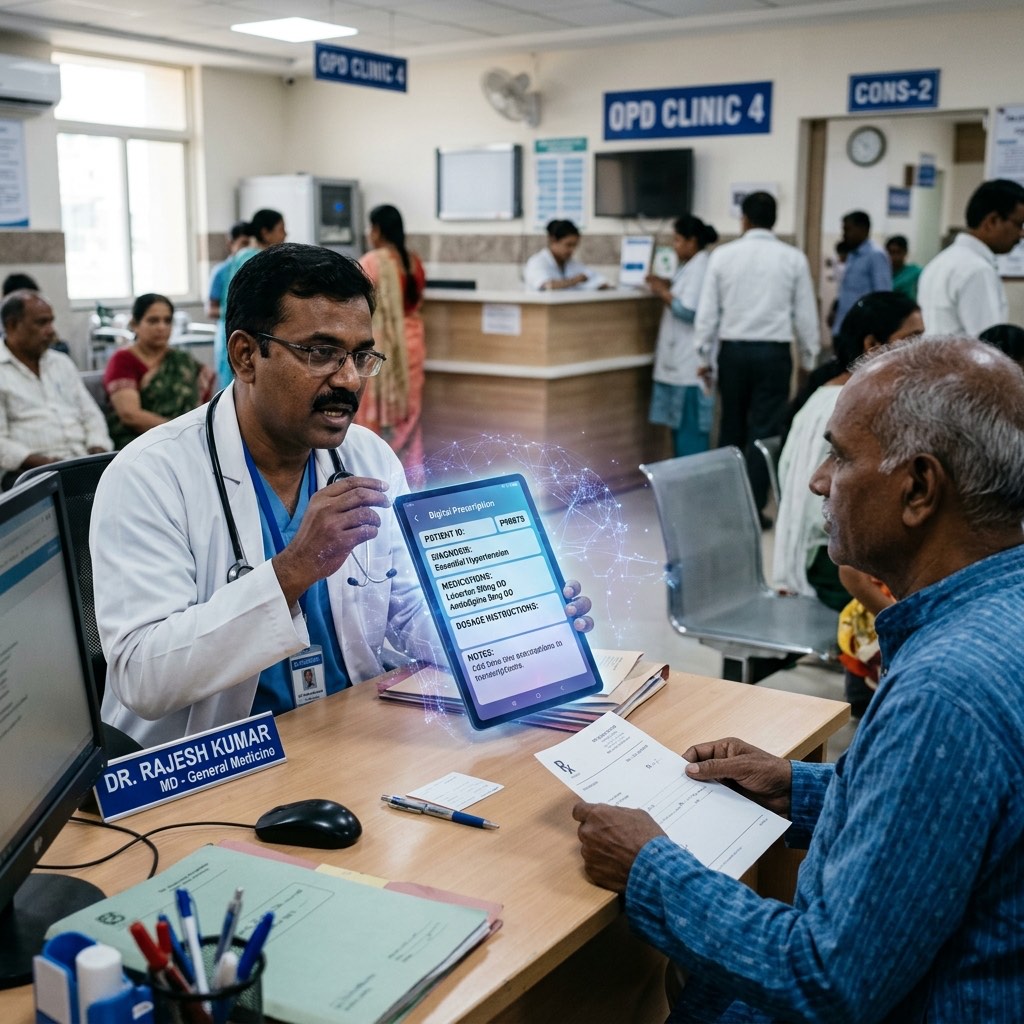
What it does: A doctor writes clinical notes by hand on a tablet. The system converts handwriting to structured digital text that populates the EMR/EHR.
What it replaces: Paper notes that get lost, scanned PDFs that are not searchable, or the awkward practice of dictating notes to a computer terminal between patients.
Why it matters: Many senior clinicians find typing disruptive to patient interaction. Handwriting on a tablet preserves the natural flow of a consultation while still producing a digital record. The output is structured — meaning fields like chief complaint, examination findings, and diagnosis are populated correctly, not just stored as a scanned image.
Lifemaan's AI tablet handwriting feature works on this principle — doctors write naturally, and the system converts it into structured EMR data. This matters for hospitals moving from paper-based workflows where asking doctors to type is a barrier to adoption.
Honest limit: Handwriting recognition accuracy depends on handwriting legibility and the training data behind the model. Rushed or highly abbreviated notes can produce errors. As with voice, the doctor needs to confirm the converted output.
3. Automatic Discharge Summary Drafting
What it does: When a patient is ready for discharge, the system pulls together the admission record, treatment history, lab results, procedures, and prescribed medications — and generates a draft discharge summary.
What it replaces: A doctor or resident spending a long stretch manually compiling and typing discharge paperwork, often late in the evening when the day's workload is already done.
Why it matters: Discharge summaries are legally required, clinically important for continuity of care, and operationally significant — a bed is not available for the next patient until discharge is complete. Delays in discharge documentation create bottlenecks that ripple across bed management.
Lifemaan generates draft discharge summaries from the IPD record. The draft covers the patient's presenting complaint, in-hospital treatment, procedures, current medications, and follow-up instructions.
Honest limit: The draft is based on what was entered into the system. If clinical data was entered incompletely or incorrectly, the summary will reflect that. The treating doctor must review, edit, and sign the final document. No AI tool should be generating discharge summaries without physician sign-off.
4. AI-Assisted Medical Coding and Documentation
What it does: Based on clinical notes and diagnoses entered into the system, AI suggests ICD-10 codes and procedure codes for billing.
What it replaces: Manual coding by billing staff who may not have clinical training, or doctors spending time on administrative billing tasks.
Why it matters: Incorrect coding leads to insurance claim rejections, delayed revenue, and compliance risk. For hospitals handling a high volume of insurance or government scheme patients (Ayushman Bharat, state schemes), coding accuracy directly affects cash flow.
Honest limit: AI coding suggestions are a starting point. A trained medical coder or billing specialist should review suggestions before submission. The AI does not understand the nuances of local insurance scheme rules without being specifically trained on them.
5. Queue and Appointment Management Using Predictive Logic
What it does: The system uses historical appointment data to predict wait times, flag likely no-shows, and help front desk staff allocate slots more effectively.
What it replaces: Guesswork about how long a particular doctor's OPD will run, manual phone-call reminders, and reactive queue management that only reacts to chaos rather than anticipating it.
Why it matters: Patient wait times are one of the most common complaints in Indian outpatient settings. Predictive queue management, even at a basic level, allows hospitals to send automated reminders, adjust slot lengths for complex cases, and communicate realistic wait times to patients.
6. Bed and Inventory Forecasting
What it does: Using admission patterns, seasonal trends, and current occupancy data, the system forecasts bed availability and flags when inventory (drugs, consumables) needs to be reordered.
What it replaces: Spreadsheet-based bed planning and reactive procurement that leads to either stock-outs or overstock.
Why it matters: Bed management is a core operational problem in Indian hospitals, especially those running at high occupancy. A system that can flag that a particular weekday consistently sees more admissions allows the hospital to plan staffing and discharge scheduling proactively.
Summary Table: AI Use Cases vs Manual Tasks
| AI Use Case | Manual Task It Replaces | Practical Benefit |
|---|---|---|
| Voice-to-Prescription (Speech-to-Rx) | Typing or handwriting prescriptions during consultation | Faster OPD throughput; fewer transcription errors |
| Tablet handwriting capture | Paper notes, scanned PDFs, typing between patients | Structured EMR entry without changing doctor behaviour |
| Auto discharge summary draft | Doctor/resident assembling and typing discharge paperwork | Faster bed turnaround; less late-night admin for residents |
| AI-assisted medical coding | Manual ICD-10 code lookup by billing staff | Fewer claim rejections; faster insurance reimbursement |
| Predictive queue management | Guesswork-based slot allocation, manual reminders | Reduced patient wait times; lower no-show rate |
| Bed and inventory forecasting | Spreadsheet tracking, reactive procurement | Better bed utilisation; fewer stock-outs |
What AI Cannot Do in a Hospital (and Shouldn't Try)
It is worth being direct about limits, because vendor claims in this space are often not.
- AI cannot replace a clinical judgment call. A prescribing decision, a differential diagnosis, a surgical call — these require a licensed doctor. No current AI tool is reliable or legally sanctioned to make these decisions autonomously in India.
- AI is only as good as the data entered. If doctors are entering incomplete records, the AI outputs will be incomplete. Garbage in, garbage out applies here as much as anywhere.
- Data privacy is a real obligation. India's Digital Personal Data Protection (DPDP) Act, 2023 creates enforceable obligations around how patient data is stored and used. If your HMS vendor is using patient data to train models without consent mechanisms in place, that is a compliance risk. Ask vendors directly about this.
- ABDM integration matters. Any system storing patient health records should be ABDM-compliant or working toward it. ABDM compliance ensures the records can be accessed by patients and shared across providers within the national digital health framework.
For a fuller picture of what to look for in any HMS before you buy, see our guide on how to choose hospital management software and our breakdown of hospital management system modules.
Evaluating AI Claims from HMS Vendors
When a vendor says their software has "AI," ask these specific questions:
- Which specific tasks does the AI handle? Get a feature-level answer, not a category-level answer.
- What languages does voice recognition support? In India, Hindi and regional language support is non-negotiable for many settings.
- Does it require internet connectivity for AI features? This affects reliability in lower-connectivity districts.
- How does the system handle errors in AI output? There should be a review and correction step built into the workflow, not just an AI output that flows directly into the record.
- What is the data privacy policy for AI model training? Does patient data stay within your hospital's database, or is it used externally?
Lifemaan is an AI-powered hospital management software built for Indian hospitals, with modules covering OPD, IPD, ICU, billing, pharmacy, EMR, and more. It has been ABDM compliant since launch and serves 576+ hospitals and clinics across India. The specific AI features described above — Speech-to-Rx, tablet handwriting capture, and auto discharge summary generation — are part of the core product.
If you are evaluating HMS options, our hospital management software pricing guide covers the cost models Indian hospitals encounter at different scales.
Ready to See These Features in Action?
The best way to evaluate whether any HMS feature works for your hospital's specific workflow is to test it in your environment. Book a free demo with Lifemaan to see Speech-to-Rx, tablet handwriting capture, and auto discharge summaries with your own patient workflow scenarios.
Frequently Asked Questions
Want to see Lifemaan in action?
Schedule a free demo for your hospital or clinic. See how easy the switch to digital can be.
Book Free Demo